Last news about IDEKO.
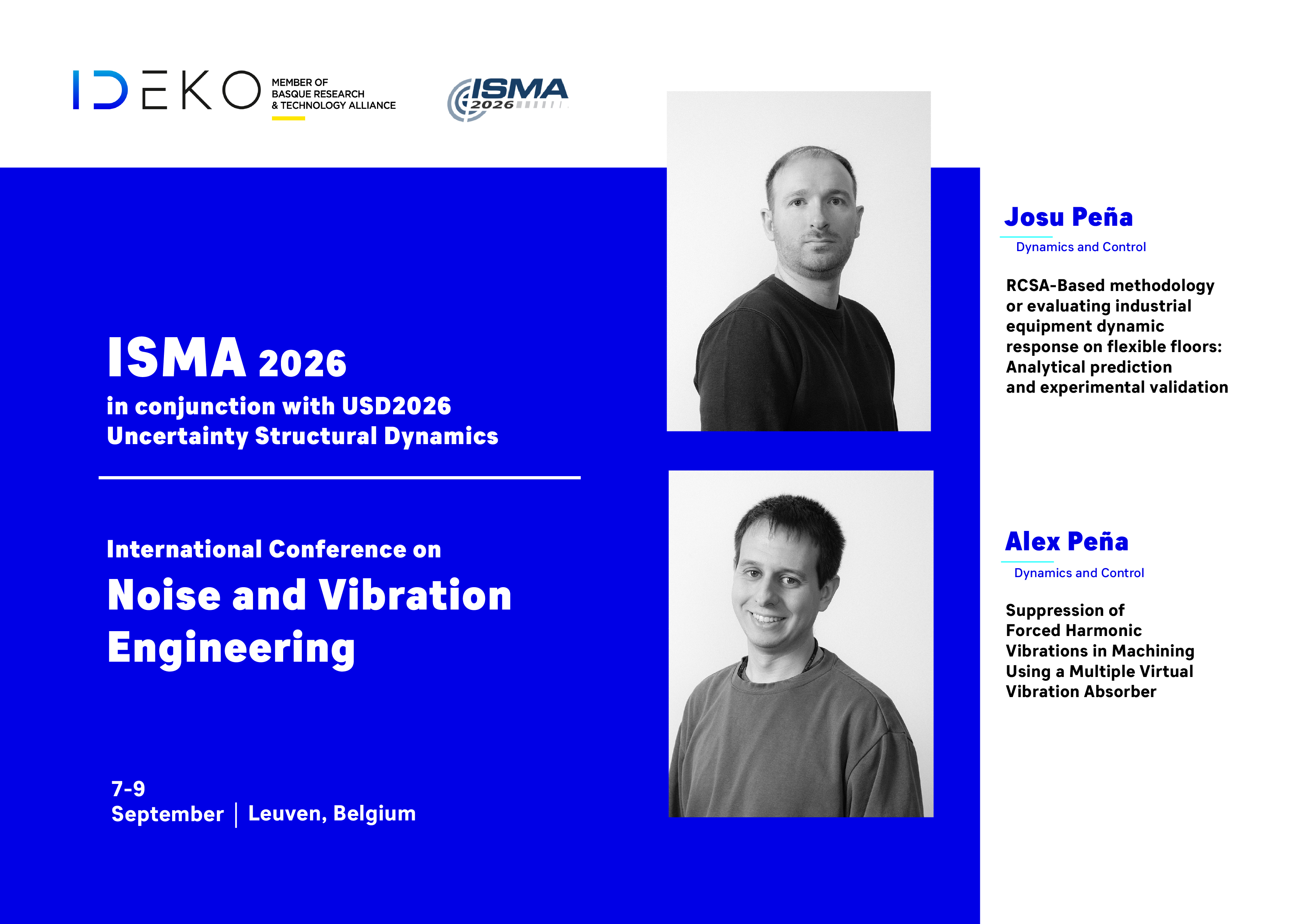
Alex Peña-Sevillano and Josu Peña presented two research studies addressing key challenges in advanced precision manufacturing at the international conference held from 7 to 9 September.
The research focuses on active vibration control during machining and on predicting the influence of flexible floors on machine dynamics.
ISMA2026 brought together experts from around the world in structural dynamics, noise and vibration engineering in Leuven, Belgium.
IDEKO, a research centre and member of the Basque Research and Technology Alliance (BRTA), took part in the international ISMA2026 conference, held in Leuven, Belgium, from 7 to 9 September.
IDEKO presented two research studies aimed at improving the dynamic behaviour of manufacturing machines and processes, one of the centre’s key areas of expertise. Both studies combine modelling, simulation and experimental validation to improve the prediction and reduction of vibrations that can compromise the precision, productivity and final quality of industrial operations.
Reducing machining vibrations by more than 91%
IDEKO researcher Alex Peña-Sevillano presented the results of a study carried out together with Iker Mancisidor, Rafael Bárcena, Rubén Merino and Jokin Muñoa, IDEKO’s Scientific Director.
The research addresses a particularly critical issue in high-precision machining: forced harmonic vibrations induced by the cutting process, which can lead to unacceptable surface quality and visible mark patterns.
To address this challenge, the team developed a novel feedback control strategy called the Multiple Virtual Vibration Absorber (MVVA). The approach employs a set of virtual resonators, each operating in counterphase with a selected harmonic to attenuate its effect. An optimal gain formulation enables effective forced vibration reduction while ensuring a chatter-free process.
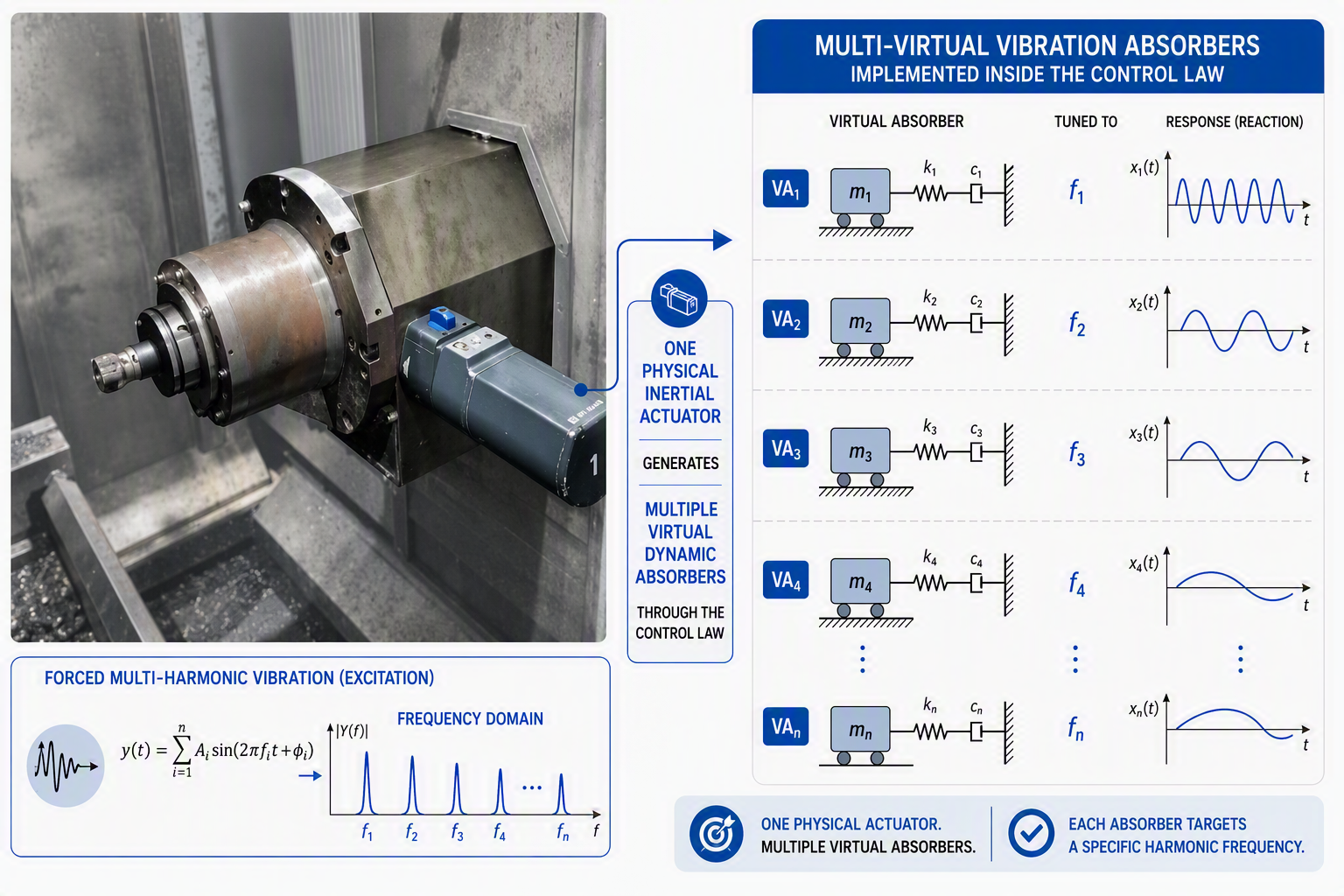
The solution also incorporates an adaptive gain control strategy into the real-time feedback loop to address actuator saturation. The proposed method was evaluated using a mechatronic model incorporating machining dynamics, structural behaviour and actuator saturation, and subsequently validated through experimental cutting tests.
The results showed a reduction in vibration amplitude of more than 91% across four different harmonics simultaneously, demonstrating the potential of the strategy to improve the surface quality and dynamic performance of high-precision machining processes.
Predicting the influence of flexible floors on machine dynamics
IDEKO’s second contribution, presented by researcher Josu Peña, focuses on another factor that can be critical for high-precision equipment: the characteristics of the supporting floor and their influence on the machine’s dynamic behaviour.
Developed together with Rubén Merino, Jokin Muñoa, Harkaitz Urreta and Josu Aguirrebeitia, the research responds to the need for reliable predictive methodologies to assess machine-floor interaction prior to installation, particularly in applications where floor flexibility may compromise operational accuracy.
The methodology is based on Receptance Coupling Substructure Assembly (RCSA) and is designed to predict the coupled dynamic response of machine-floor assemblies. The floor is experimentally characterised by modal testing, while the equipment is represented using finite element modelling. Both substructures are then coupled through the RCSA approach, enabling an accurate prediction of the floor influence on machine dynamics.
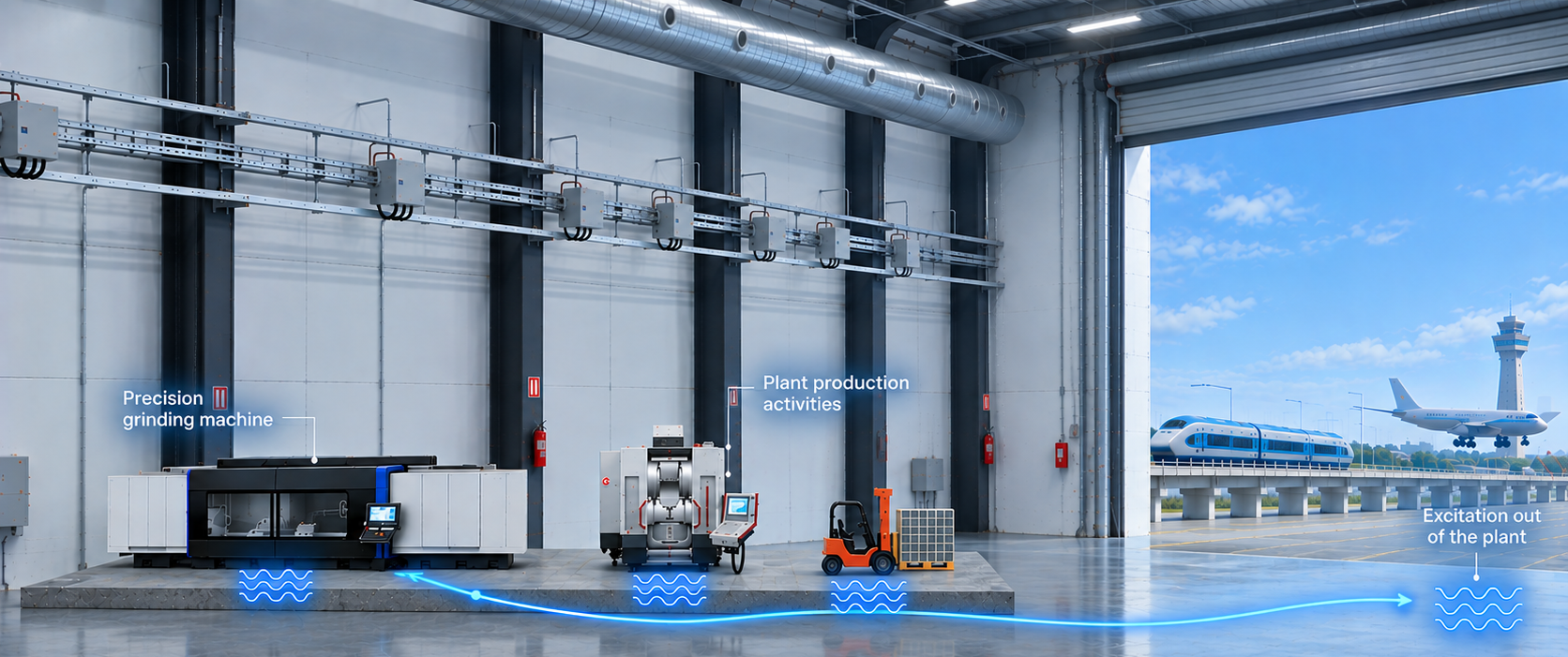
The methodology was experimentally validated through a case study involving high-speed spindle test benches on a flexible intermediate floor, demonstrating its suitability as a decision-support tool for machine installation on flexible floors.
Together, the two studies offer complementary approaches to improving the dynamic performance of high-precision manufacturing systems. While Alex Peña-Sevillano’s research focuses on attenuating forced harmonic vibrations during the machining process, Josu Peña’s work provides a methodology for predicting machine-floor interaction before installation.
This combination of modelling, simulation, control and experimental validation is central to IDEKO’s expertise in machine and process dynamics, with the aim of turning advanced research into solutions that enable industry to manufacture with greater precision, stability and productivity.
ISMA2026 placed particular emphasis on combining experimental and numerical methods and applying them to mechanical and mechatronic systems, alongside emerging fields such as digital twins, model-based engineering and artificial intelligence. Modal analysis and structural dynamics testing also remain two of the conference’s core scientific areas.
Organised by the Department of Mechanical Engineering at KU Leuven, ISMA celebrated its 32nd edition this year, continuing a series that began in 1975 around structural dynamics, modal analysis, and noise and vibration engineering. The conference brings together researchers, engineers and industry professionals to share advances in the modelling, analysis, testing and control of mechanical and mechatronic systems, with a particular focus on bridging academic research and industrial applications.





.jpg)